Amazon
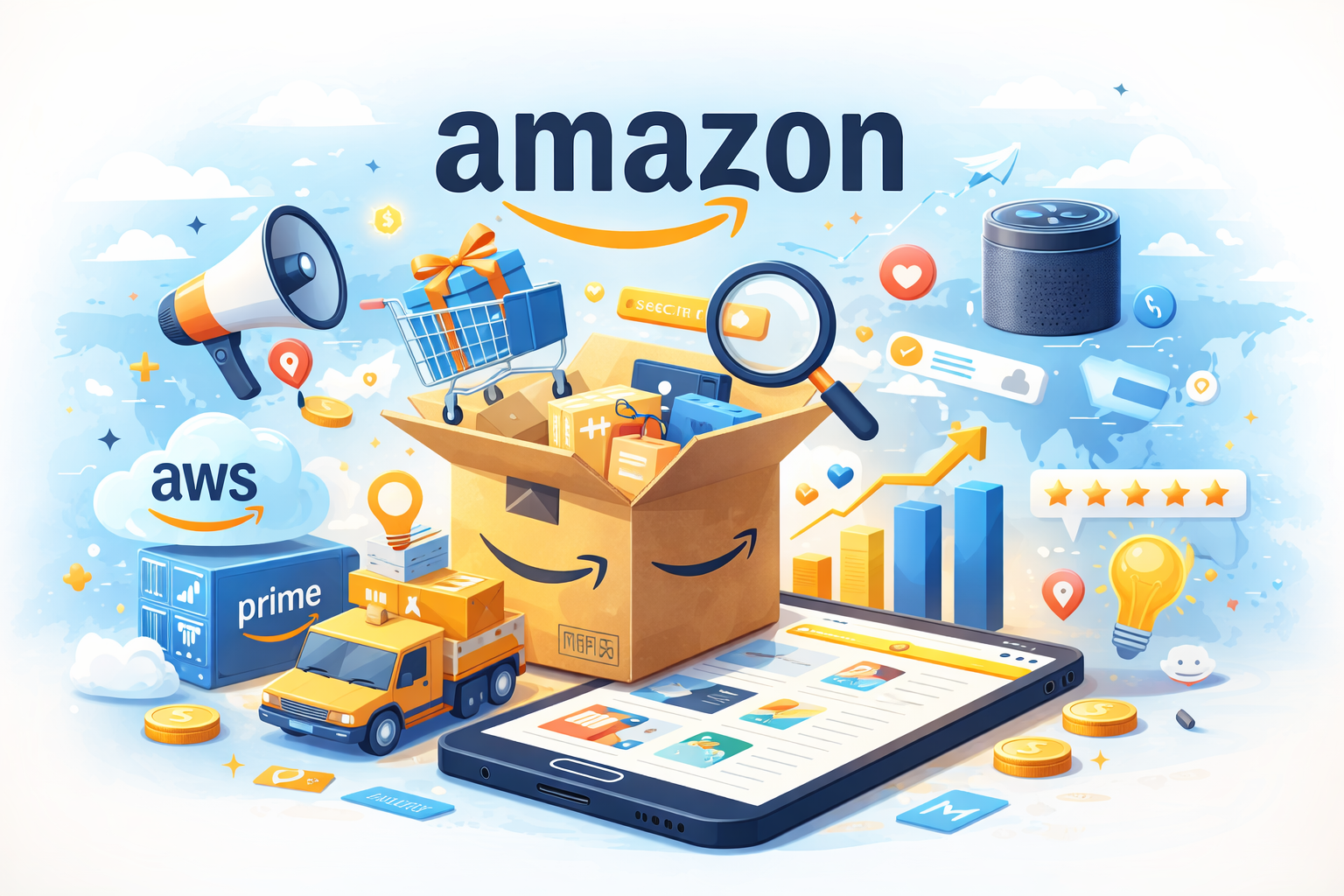
Amazon is no longer just a company; it is a global ecosystem that touches nearly every part of modern life. From online shopping and cloud computing to entertainment, logistics, and artificial intelligence, Amazon has reshaped how people buy, sell, work, and consume content. What began as a simple online bookstore has evolved into one of the most powerful corporations in the world.
For everyday consumers, Amazon represents convenience. For businesses, it represents opportunity and competition. For creators and sellers, it is both a platform and a challenge. Understanding Amazon today means understanding how digital commerce, technology, and global infrastructure intersect in real time.
This in-depth article explores Amazon from every angle—its origins, its business model, its services, its impact, and its future. Written in a clear, casual style but backed by expert insight, this guide explains not just what Amazon is, but why it matters more than ever.
The Origins of Amazon and Its Early Vision
Amazon was founded in 1994 by Jeff Bezos, at a time when the internet was still new and largely unexplored. Bezos saw an opportunity in the rapid growth of the web and believed that online retail could scale faster and more efficiently than traditional brick-and-mortar stores. Books were chosen as the starting point because they were easy to ship and had a massive catalog.
In its earliest days, Amazon focused obsessively on customer experience. Fast shipping, a wide selection, and competitive pricing became the pillars of its strategy. Rather than maximizing short-term profit, Amazon reinvested heavily in infrastructure, technology, and logistics, a decision that puzzled critics but laid the foundation for massive long-term growth.
What made Amazon different from the beginning was its mindset. It didn’t see itself as a bookstore, but as a technology company that happened to sell books. That distinction shaped every major decision that followed and allowed Amazon to expand far beyond its original niche.
Amazon’s Business Model Explained Simply
Amazon’s business model is complex, but at its core, it is built on scale, efficiency, and data. Unlike traditional retailers that rely mainly on product margins, Amazon generates revenue from multiple interconnected streams that support one another.
Retail sales are the most visible part of Amazon’s business, but they are not the most profitable. Amazon sells products directly, hosts third-party sellers, and earns fees from listings, fulfillment, advertising, and subscriptions. This multi-layered approach allows Amazon to earn revenue even when it doesn’t own the inventory.
Another key element of Amazon’s model is reinvestment. Instead of distributing profits aggressively, Amazon continuously invests in automation, logistics, artificial intelligence, and global expansion. This long-term approach has allowed it to stay ahead of competitors while building infrastructure that would be nearly impossible to replicate.
Amazon Marketplace and the Rise of Third-Party Sellers
One of Amazon’s most powerful innovations is its marketplace model. Today, more than half of all products sold on Amazon come from third-party sellers rather than Amazon itself. This shift transformed Amazon from a retailer into a global commerce platform.
For sellers, Amazon offers instant access to millions of customers, advanced logistics, and trusted payment systems. Small businesses can scale rapidly without building their own websites or warehouses. At the same time, competition is intense, and sellers must navigate fees, policies, and algorithm changes.
The marketplace model benefits Amazon enormously. It reduces inventory risk while increasing product selection. Amazon earns revenue through commissions, fulfillment fees, and advertising, making the platform profitable even when margins are tight for sellers.
Fulfillment by Amazon and the Logistics Revolution
Fulfillment by Amazon, commonly known as FBA, changed the logistics industry forever. With FBA, sellers store products in Amazon’s warehouses, and Amazon handles storage, packing, shipping, customer service, and returns.
This system allows Amazon to control delivery speed and quality, which directly improves customer satisfaction. Fast shipping, including same-day and next-day delivery, has become an expectation rather than a luxury.
Behind the scenes, Amazon operates one of the most advanced logistics networks in the world. Robotics, predictive analytics, and real-time inventory tracking allow Amazon to move products efficiently across continents. This logistics dominance is one of Amazon’s strongest competitive advantages.
Amazon Prime and the Power of Subscriptions
Amazon Prime is one of the most successful subscription programs ever created. What started as a free-shipping membership has evolved into a comprehensive bundle of services that includes video streaming, music, exclusive deals, cloud storage, and more.
Prime creates loyalty. Members shop more frequently, spend more per order, and are less likely to compare prices elsewhere. The psychological value of “free shipping” encourages impulse purchases and repeat behavior.
From a business perspective, Prime provides predictable recurring revenue while strengthening Amazon’s ecosystem. Once users are inside the Prime experience, they are more likely to use other Amazon services, creating long-term customer retention.
Amazon Web Services and the Backbone of the Internet
Amazon Web Services, or AWS, is one of the most important yet least visible parts of Amazon’s empire. AWS provides cloud computing infrastructure to businesses, governments, and startups worldwide.
Many of the world’s most popular websites, apps, and services run on AWS. From streaming platforms to financial systems, AWS powers a significant portion of the internet. This division generates a large share of Amazon’s operating profit.
AWS succeeded because Amazon applied its internal infrastructure needs to external customers. What began as an internal solution became a global product, proving Amazon’s ability to turn operational efficiency into new business opportunities.
Amazon’s Role in Entertainment and Digital Media
Amazon has become a major player in entertainment through Prime Video, music streaming, audiobooks, and gaming. These services are not just standalone products; they enhance the overall Prime ecosystem.
Prime Video invests heavily in original content, including movies, series, and live sports. The goal is not just viewership, but engagement. The more time users spend within Amazon’s ecosystem, the stronger their loyalty becomes.
By integrating entertainment with commerce, Amazon blurs the line between content and shopping. Viewers can discover products through shows, shop instantly, and remain within a single platform.
Amazon Advertising and the Data Advantage
Amazon has quietly become one of the world’s largest advertising platforms. Brands pay to promote products directly where purchasing decisions are made—on search results and product pages.
Unlike traditional advertising platforms, Amazon’s ads are closely tied to purchase intent. Amazon knows what customers search for, view, and buy, making its advertising data extremely valuable.
This advertising revenue adds another profitable layer to Amazon’s ecosystem while helping sellers gain visibility in a crowded marketplace.
Amazon’s Impact on Global Retail
Amazon has reshaped retail expectations worldwide. Fast shipping, easy returns, transparent pricing, and vast selection have become standard benchmarks that competitors must meet.
Traditional retailers have been forced to adapt by improving online presence, logistics, and customer experience. Some have partnered with Amazon, while others compete directly.
This transformation has benefits and challenges. Consumers enjoy convenience and choice, but small retailers face pressure to innovate or differentiate in a rapidly evolving market.
Workplace Culture and Labor Considerations
Amazon’s scale requires a massive workforce across warehouses, offices, and delivery networks. Its workplace practices are frequently discussed and debated.
Supporters highlight job creation, competitive wages, and career advancement opportunities. Critics raise concerns about working conditions, performance metrics, and work-life balance.
These discussions reflect broader conversations about labor in the digital economy. Amazon’s influence means its policies often shape industry standards.
Innovation, AI, and Amazon’s Future Technologies
Amazon continues to invest heavily in artificial intelligence, automation, and machine learning. These technologies improve recommendations, logistics efficiency, voice assistants, and customer service.
Alexa, Amazon’s voice assistant, represents a long-term vision of ambient computing. By embedding technology into daily life, Amazon aims to remain present beyond screens.
Innovation at Amazon is driven by experimentation. Not every project succeeds, but the company’s willingness to test, fail, and iterate keeps it ahead of slower competitors.
Amazon’s Global Expansion Strategy
Amazon operates in dozens of countries, adapting its platform to local markets, regulations, and consumer behavior. Expansion is strategic rather than uniform.
In some regions, Amazon focuses on logistics first. In others, it emphasizes digital services or partnerships. This flexibility allows Amazon to grow while managing risk.
Global expansion also brings regulatory scrutiny, requiring Amazon to balance innovation with compliance.
Criticism, Regulation, and Public Perception
Amazon’s size attracts attention from regulators and policymakers worldwide. Issues such as market dominance, data usage, taxation, and competition are under constant review.
Public perception of Amazon is complex. Consumers appreciate convenience, while critics question its influence on small businesses and local economies.
These debates will shape Amazon’s future as governments seek to balance innovation with fairness.
Why Amazon Continues to Dominate
Amazon’s dominance is not accidental. It results from long-term thinking, customer obsession, technological investment, and operational excellence.
Rather than focusing on single products, Amazon builds systems. Each service strengthens the others, creating an ecosystem that is difficult to leave or replicate.
This integrated approach ensures resilience, even as markets change.
Final Thoughts on Amazon’s Lasting Influence
Amazon is more than an online store. It is a reflection of how technology, commerce, and data intersect in the modern world. Its influence reaches far beyond shopping carts and delivery boxes.
Understanding Amazon helps explain broader trends in digital business, consumer behavior, and global logistics. Whether admired or criticized, Amazon remains one of the defining companies of our time.
As Amazon continues to evolve, one thing is certain: its impact on how the world buys, sells, and connects is far from over.
YOU MAY ALSO READ
About the Author